How to Plan a Workday That Actually Fits Your Brain
Nov 25, 2025
Read Time: 8 minutes
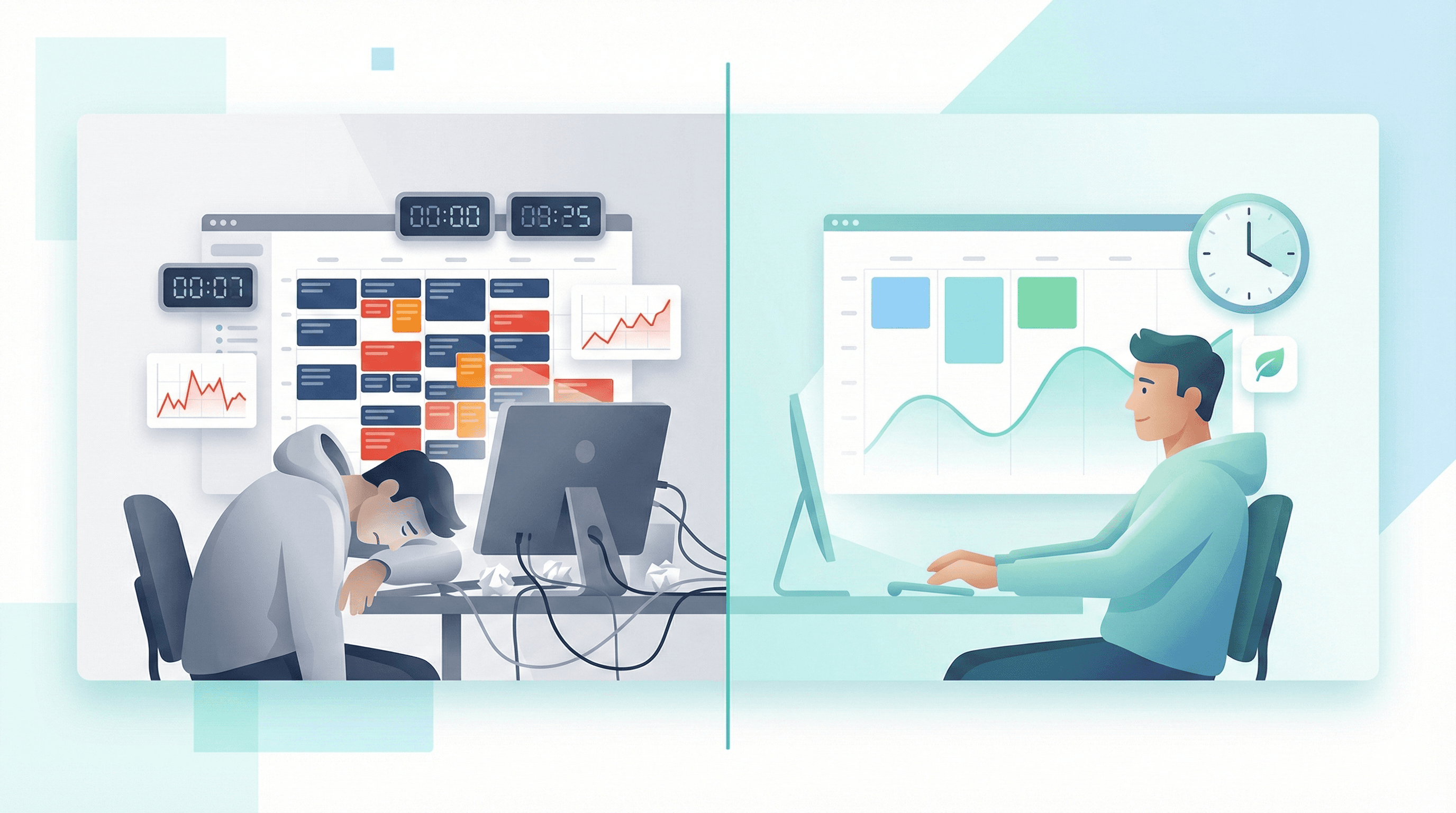
Time management is linear; energy is cyclical.
You already know the feeling: a “free” hour on your calendar that isn’t actually usable. The time is there, but your brain is cooked. That’s the gap between time management and energy management. Time management asks, “Where do I put this task?” Energy management asks, “When am I actually capable of doing this well?” This article is about the second question and how and why you should design your workday around it.
We often treat ourselves like machines that can run at high speed as long as we keep shoveling coal (coffee) into the furnace. But the science of Chronobiology proves we operate in waves. The most critical concept here is the Ultradian Rhythm. Research originally pioneered by sleep researcher Nathaniel Kleitman suggests that just as we cycle through sleep stages, we cycle through alertness stages during the day. These cycles typically last 90–120 minutes.
Once you push past that peak, your brain enters a "trough." No amount of time-blocking can force high-level output during a biological trough.
3 Proven Methods to Organize Around Energy
You don't need to throw away your calendar. You just need to overlay it with an energy map. Here are three practical frameworks backed by behavioral science to restructure your day.
1. The "Maker vs. Manager" Split
This concept, popularized by computer scientist Paul Graham, is the gold standard for energy defense.
The Logic: "Manager" tasks (meetings, emails, updates) require low-voltage, frequent context switching. "Maker" tasks (coding, writing, designing) requires high-voltage, sustained focus.
The Fix: Do not sprinkle meetings throughout your day like confetti. That fragments your energy.
Morning: Block 3 hours for Maker time. No Slack. No Zoom. This is your "Deep Work" window.
Afternoon: Batch all Manager tasks. Do your calls, emails, and stand-ups back-to-back when your creative battery is already draining.
2. The "Peak-Trough-Recovery" Rule
In his book When: The Scientific Secrets of Perfect Timing, Daniel Pink analyzed millions of data points to find a consistent pattern in human energy: a peak, a trough, and a rebound.
The Logic: Analytic capabilities peak in the morning. Creative/Insight capabilities peak during the "rebound" (late afternoon/early evening). The trough (early afternoon) is a dead zone.
The Fix:
9 AM - 11 AM (The Peak): Schedule analytic tasks. Spreadsheets, bug fixes, financial planning.
1 PM - 3 PM (The Trough): Schedule administrative "garbage" time. Expense reports, low-stakes catch-up calls.
4 PM - 6 PM (The Rebound): Schedule brainstorming. This is when your inhibitions are lower, allowing for looser, more creative thinking.
3. The Green/Red Calendar Audit
If you don't know your own rhythms yet, you need to visualize them.
The Logic: We are bad at predicting how draining a task will be. We assume a 30-minute meeting costs 30 minutes. In reality, a stressful 30-minute meeting can cost 2 hours of recovery energy.
The Fix: Look at your to-do list for tomorrow. Color code it.
Green: Tasks that give you energy or flow (building, solving).
Red: Tasks that drain you (conflict, admin, bureaucracy).
The Rule: Try not to schedule two "Red" tasks back-to-back. Always sandwich a Red task with a recovery period or a Green task. Always experiment and see what works best for you!
Stop "Powering Through" For Long Periods of Time
The biggest mistake in energy management is ignoring the “signs”. When you are starting to feel the fog rolling in, usually after about 90 minutes of focus, your instinct is to grab caffeine and push harder.
Don't.
That fog is your brain’s way of saying your sources are getting depleted and you need a reset. A 15-minute walk outside will do more for your productivity than an hour of staring at the screen.
Setup: The Calendar That Thinks Like You
We built Setup because traditional calendars don't care if you are burning out. They only care if you are busy.
Setup allows you to tag tasks not just by time, but by energy demand. It helps you visualize your "Red" and "Green" tasks so you can build a day that flows with your biology, rather than fighting against it.
Summary
Time Management asks: "How can I fit this in?"
Energy Management asks: "When am I best equipped to do this?"
You can have the most perfectly organized Google Calendar in the world, but if you are scheduling creative work during your biological trough, you are setting yourself up to fail. Respect the rhythm.